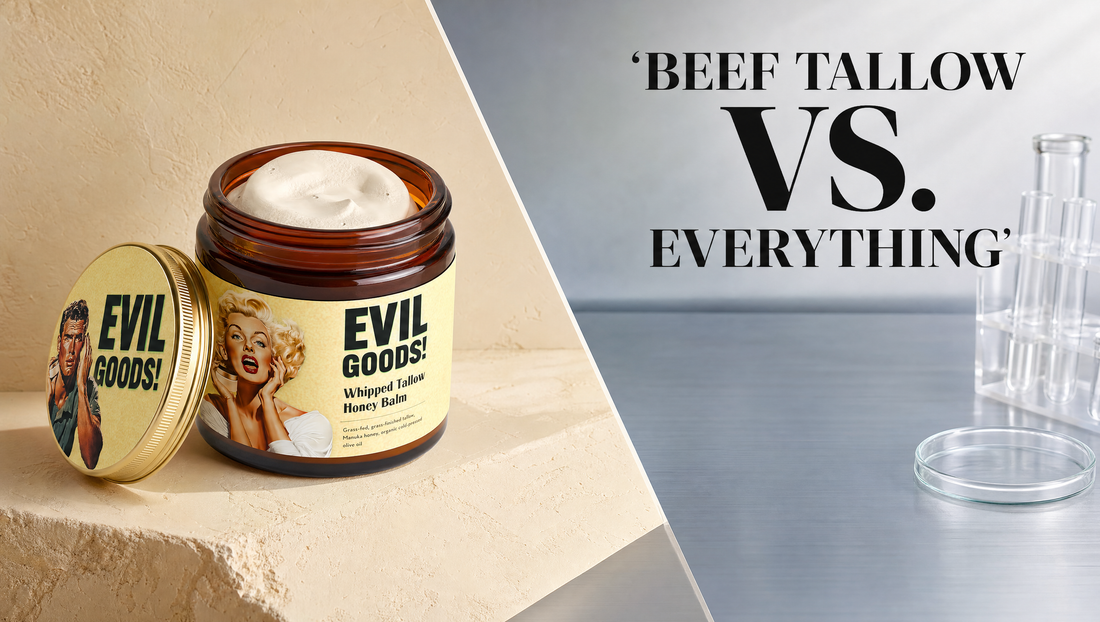
Every "active ingredient" in the skincare aisle is, in one way or another, an attempt to copy something your skin already knows how to use. Ceramides mimic your skin's own lipids. Retinol is synthetic vitamin A. Petrolatum just seals moisture in. Beef tallow brings a lot of that to the table in one whole ingredient — so the honest question isn't "is tallow good," it's "how does it stack up against what you're already paying for?" Here are the straight comparisons.
Tallow vs. ceramides
Ceramides are lab-made versions of lipids your skin produces naturally, sold to help reinforce the look and feel of your skin's surface. Tallow takes a different route to a similar destination: instead of supplying one isolated lipid, it delivers a whole fatty-acid profile close to your skin's own sebum, plus fat-soluble vitamins A, D, E, and K. Ceramide serums can be elegant and lightweight; tallow is richer and more complete, and it does it with one ingredient instead of a formula.
Tallow vs. shea butter
Both are rich, both are plant-or-animal whole fats, both moisturize beautifully. The practical difference is compatibility: tallow's fats more closely resemble human sebum, so many people find it absorbs rather than sitting heavy, while shea can feel waxier. Shea is a great vegan option; tallow tends to win on how readily skin takes it up.
Tallow vs. petrolatum (Vaseline & co.)
Petrolatum is an occlusive — it forms a barrier that slows water loss, but it doesn't feed your skin anything. It sits on top by design. Tallow does the moisturizing-barrier job and carries vitamins and fatty acids your skin can actually use. If the choice is "a petroleum byproduct that seals" versus "a nutrient-rich fat that absorbs," that's not a hard call for most people.
Tallow vs. retinol
Retinol is the anti-aging aisle's headliner — and it's a synthetic form of vitamin A, which tallow carries naturally. Retinol can be effective but is famous for irritation, peeling, and sun sensitivity, which is why so many people quit it. Tallow offers vitamin A in its natural form within a gentle, whole-fat base. It's the difference between the lab's copy and the original. (We keep claims honest here: tallow isn't a prescription treatment — it's a gentler, naturally vitamin-A-rich alternative for people the strong stuff didn't agree with.)
How to spot a quality tallow balm vs. a cheap knockoff
The category filled up fast, and not all of it is good. What separates the real thing:
- Grass-fed, grass-finished — the single biggest quality lever, and the first thing knockoffs cut. More on why in our complete tallow guide.
- A short, legible ingredient list — tallow plus a few recognizable additions, not a synthetic supporting cast.
- Whipped texture — properly whipped tallow glides on; cheap renders feel dense and greasy.
- No synthetic fragrance — see our non-toxic skincare guide for why that word matters.
So — is beef tallow skincare worth it?
If you want a lightweight serum and a 10-step routine, tallow isn't that. If you're tired of paying for formulas that left your skin drier and more confused than when you started, and you want one honest ingredient that moisturizes and softens, it's worth a jar. We back it with a 30-day money-back guarantee precisely because the best way to settle a comparison is to feel it on your own skin. The technique that makes it shine is in our how-to-use guide.
Frequently asked questions
Is tallow better than ceramides for dry skin?
They work differently — ceramides reinforce the surface, tallow delivers a whole range of fats and vitamins. Many people with persistent dryness prefer tallow's richness; the honest answer is to try it.
Can I use tallow instead of retinol?
Tallow carries vitamin A naturally and far more gently, but it isn't a clinical retinoid. For people who couldn't tolerate retinol's irritation, it's a popular natural alternative.
Why is grass-finished tallow worth more?
Pasture-raised, grass-finished cows yield fat with a richer nutrient and fatty-acid profile — the quality that cheaper, grain-fed tallow lacks.
Related reading
- What makes the best tallow for skin
- How not to get scammed buying a tallow balm
- Making your own tallow balm (and why most don't)
The fastest way to win any of these comparisons is to feel it. Grab a jar of the Whipped Tallow & Manuka Honey Moisturizer — Subscribe & Save 30% on your first order, 30 days to change your mind, no drama, no hoops.

Dr. Elena Dinkollari
MD, Dermatologist & Endocrinology Assistant

Doctor Approved